“A typical human chromosome has one very long DNA molecule wound into coils, so that the space it occupies is very much smaller than it would be if it were unraveled. This DNA molecule is composed of smaller building blocks, a little like the rungs and sides of a rope ladder. These blocks are called nucleotides and come in four varieties. The language of life, our hereditary information, is determined by the sequence of the four different sorts of nucleotides. We might say that the language of heredity is written in an alphabet of only four letters.
But the book of life is very rich; a typical chromosomal DNA molecule in a human being is composed of about five billion pairs of nucleotides. The genetic instructions of all the other taxa on Earth are written in the same language, with the same code book. Indeed, this shared genetic language is one line of evidence that all the organisms on Earth are descended from a single ancestor, a single instance of the origin of life some four billion years ago”
“If there are approximately six letters in an average word, the information content of a human chromosome corresponds to about five hundred million words (3 × 10⁹/6 = 5 × 10⁸). If there are about three hundred words on an ordinary page of printed type, this corresponds to about two million pages (5 × 10⁸/3 × 102 ≅ 2 × 10⁶). If a typical book contains five hundred such pages, the information content of a single human chromosome corresponds to some four thousand volumes (2 × 10⁶/5 × 102 = 4 × 10³).”
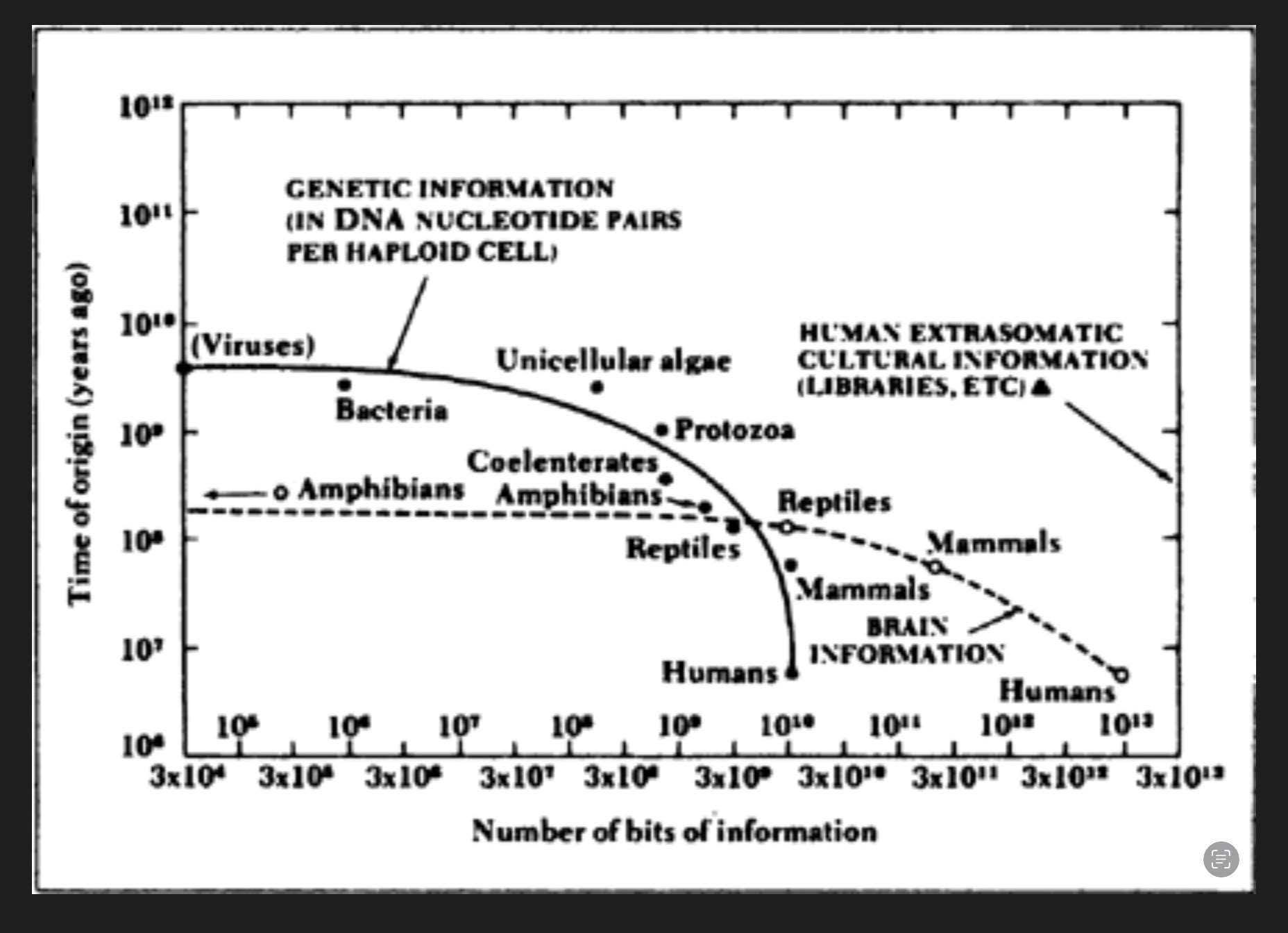
“Large organisms such as human beings average about one mutation per ten gametes—that is, there is a 10 percent chance that any given sperm or egg cell produced will have a new and inheritable change in the genetic instructions that determine the makeup of the next generation. These mutations occur at random and are almost uniformly harmful—it is rare that a precision machine is improved by a random change in the instructions for making it.”
“a modern [1996] computer able to process the information in the human brain would have to be about ten thousand times larger in volume than the human brain. On the other hand, modern electronic computers are capable of processing information at a rate of 1016 to 1017 bits per second, compared to a peak rate ten billion times slower in the brain. The brain must be extraordinarily cleverly packaged and “wired,” with such a small total information content and so low a processing rate, to be able to do so many significant tasks so much better than the best computer.”